Welcome To My Community Work.
I firmly believe that the strongest science comes out of the strongest scientific communities. Within these communities, we celebrate differences, empower the next generation, and uplift one another in the mutual effort to better understand the universe to which we all belong. Throughout my time at Rutgers, I have dedicated myself to this vision through the programs below.
Project BUILD
I have been involved with Project BUILD since it's second year and currently serve as a co-facilitator with Emily McPike and Catherine Manea. Project BUILD (Building Undergraduate Internships through Leadership Development) is a cross-institutional discussion group designed to connect current or aspiring mentors across the astro grad, postdoc, and faculty communities.
The primary purpose of Project BUILD is to address the dearth of prepared mentors compared to the number of undergraduate students looking for research projects in astronomy. Through Project BUILD, we hope to leverage each other's experiences and skills to (1) grow our toolboxes of mentoring best practices, (2) develop sophisticated yet attainable projects for undergraduate students, and (3) and foster a safe community space to share experiences and grow together.


Rutgers Minorities in Physics & Astronomy (MiPA) Organization
During my time at Rutgers, I have spent one year as Vice President of MiPA and two years as President. MiPA brings together undergrads, graduate students, post-docs, and faculty who identify as underrepresented minorities in Physics & Astronomy. As an organization, we aim to strengthen community amongst underrepresented minorities, engage in advocacy work, improve department culture and conditions, and expand our understanding and appreciation for different underrepresented groups. In addition to weekly meetings, MiPA hosts a monthly department-wide Equity and Inclusion Journal Club. During my time leading MiPA, we have introduced monthly Undergraduate Tea Time events, where undergrads and grad students have the opportunity to build mentor/mentee relationships and talk about career progress. We also introduced an Equity and Inclusion Book Club, designed to build a deeper understanding of different communities, celebrate literature that allows us to feel seen, and encourage dialog about effective community building. Additionally, we have begun to engage in community service efforts with local organizations like Iris House, packing over 1000 HIV/AIDS prevention kits.
Rutgers High School Physics Outreach Program
Throughout my time in graduate school, I have been volunteering with our local high school physics outreach program as the Demonstrations Coordinator. For this program, we travel to the New Brunswick Health Sciences Technology High School three times a year to share fun physics demos that connect with the students' coursework. Some of my (and the students') favorite demos include our fire extinguisher powered cart; He, Ne, and Mg lamps with diffraction goggles (pictured); and our singing resonance bowl!


CAPYBARA Initiative
In 2024, fellow graduate student, Daniel Piacitelli, and I started the Contributing to Astronomy+PhYsics and Beyond with Academic Resources for Advancement (CAPYBARA) initiative. We started CAPYBARA because we realized that succeeding in undergrad and advancing to higher education/industry with a background in (astro)physics requires information that is not readily and evenly passed on to all undergraduate students. This information is often referred to as the “hidden curriculum”, and it is typically only taught to students who already have close ties to higher education or who have been lucky enough to gain mentorship early on. Uncovering the hidden curriculum helps to level the playing field for students from underrepresented backgrounds and improves the scientific community at large. We have thus created this website, which includes supplementary tools to prepare Rutgers undergraduate students for research and career advancement.
Rutgers Aresty Undergraduate Research Program
Since 2023, I have been co-advising two undergraduate students who joined the Gawiser research group through the Aresty Undergraduate Research Program. This has been one of the most rewarding parts of my graduate experience, and has taught me countless lessons. Both of my students are now each leading their own publication. Bailey Thompson and I have been working on a comparison of source detection algorithms in order to understand how their systematics leave imprints on galaxy selection and impact our cosmological measurements. Govind Ramgopal and I have been working on a pipeline for machine learning-aided Lyman Alpha Emitting Galaxy selection. Stay tuned!
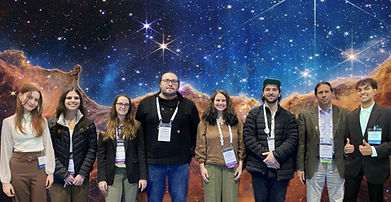

Rutgers Physics & Astronomy Graduate Student Organization
For two years I served as the Graduate Student Life Committee Liaison for the Rutgers Physics & Astronomy Graduate Student Organization. In this role, I have helped to support my peers work through challenging interpersonal situations, navigate degree progress in light of personal circumstances, and strategize funding uncertainties. Additionally, I have worked with the graduate program director to insure that the values and concerns of graduate students are reflected in departmental discussions and decisions.